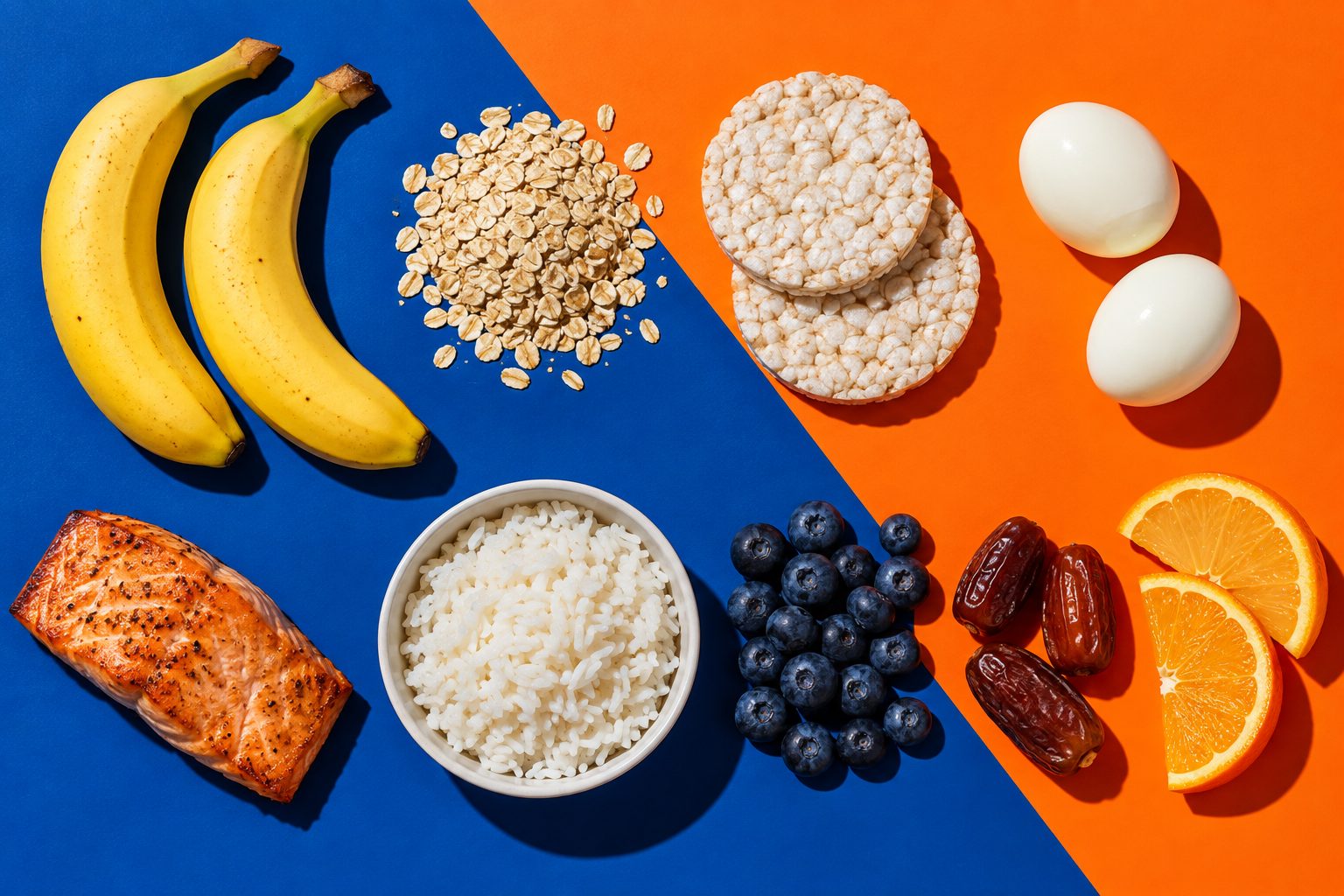
Stuck at the Same Lifts for Months? Check Your Nutrition Before Your Program
When strength stalls, most people change the workout. Often the real bottleneck is on the plate: not enough food, not enough protein, or numbers that only look right in the app.

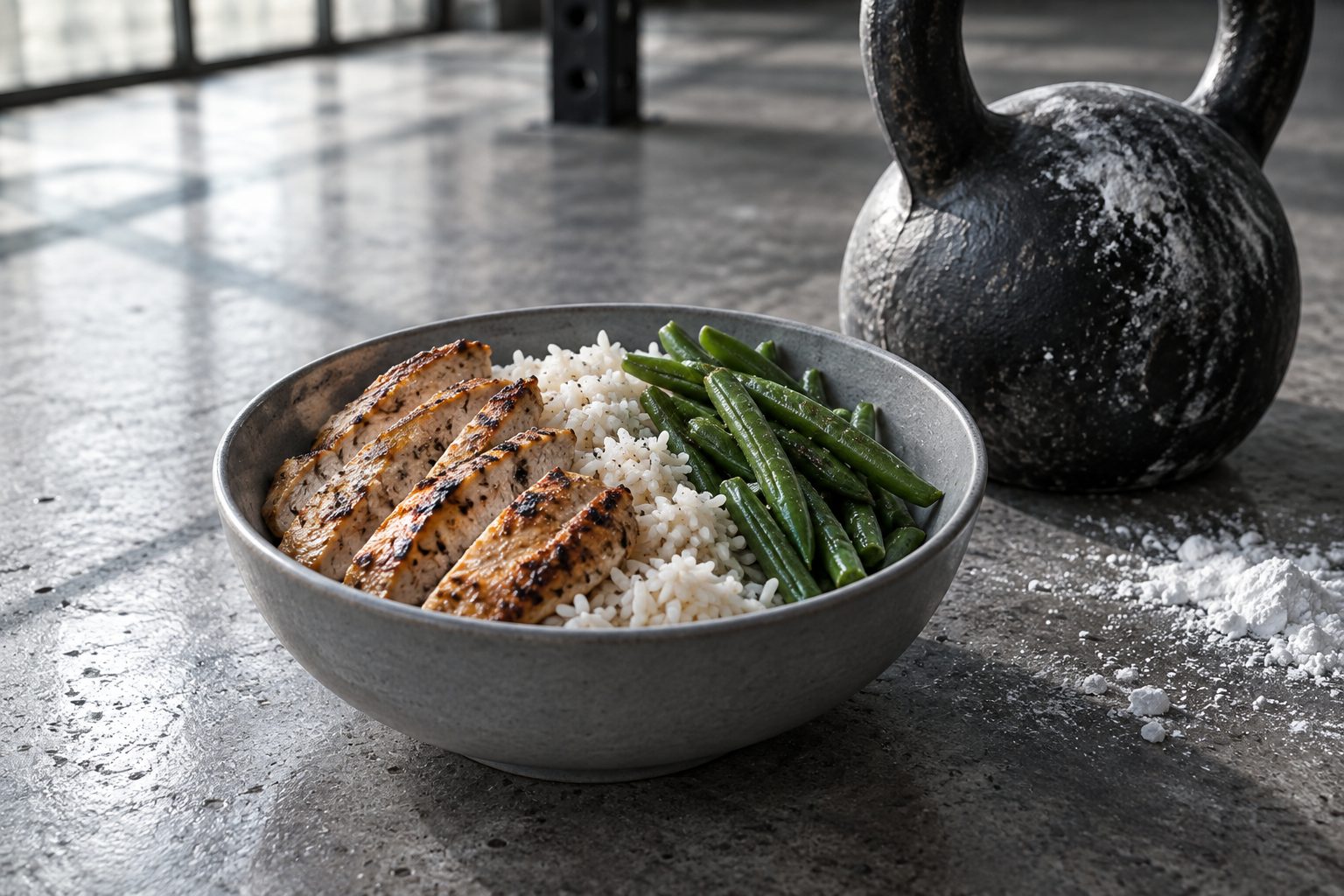
Your bench has been stuck at the same weight for eight weeks. You’ve switched programs, added a set, tried new rep schemes. Your training log looks disciplined, your food log says you’re eating plenty, and still nothing moves. The natural reaction is to blame the program again.
Before you do, check the other half of the equation. Training creates the signal to get stronger; food decides whether your body has the material to answer it. For recreational lifters, an under-fueled body is one of the most common and least checked reasons for a plateau. This guide walks through a quick triage, two simple checks you can run today, and a four-week reset.
- Before changing your program, check energy, protein and sleep, in that order.
- To build, aim for a bodyweight gain of about 0.25 to 0.5% per week. A flat trend means maintenance, whatever the log says.
- Protein’s benefit levels off around 1.6 g/kg a day; about 0.4 g/kg per meal over four meals is practical.
- Eyeballed logs often overstate protein and calories. One weighed week shows the truth.
Plateaus are normal. Long ones deserve a checkup.
Progress always slows as you get more experienced. A beginner can add weight to the bar almost every week; after a few years, a few kilos a year is a great result. A short stall is part of training. But if your main lifts haven’t moved in two or three months despite consistent, well-planned training, something in the system is usually missing, and the cheapest things to check are food, protein and sleep.
Run the triage
Answer honestly, one question at a time. The order matters: there’s no point fine-tuning protein if you’re eating far too little overall.
Your program creates the signal. Your plate decides whether your body can answer it.
Check 1: are you really in a surplus?
Building muscle and strength is much easier with a small energy surplus. A 2019 review of evidence for bodybuilders recommends a surplus of roughly 10 to 20% that produces a gain of about 0.25 to 0.5% of bodyweight per week for beginners and intermediates, and less for advanced lifters. Your food log can say “surplus” all day; your bodyweight trend is the real verdict. Enter two weekly averages a few weeks apart:
If your weight has been flat for weeks, you’re eating at maintenance, whatever the log says. That’s fine for maintaining, but it makes adding strength and size slower, especially after the beginner phase. If you’re trying to lose fat at the same time, expect strength to hold rather than climb, and judge progress accordingly.
Check 2: is your protein high enough?
A large 2018 meta-analysis in the British Journal of Sports Medicine found that the benefit of protein for muscle gains with resistance training levels off at about 1.6 g per kg of bodyweight per day, with some people benefiting from up to about 2.2 g/kg. Spread over the day, about 0.4 g/kg per meal across at least four meals is a practical target. For a 75 kg lifter, that’s about 120 g a day, or 30 g per meal.
The trouble is that protein is easy to overestimate. A “palm” of chicken, a “scoop” of yogurt and a splash of milk can feel like 40 g and be 25. Our guide to the protein-first method shows how to build meals that hit the number on purpose.
When the log says one thing and the plate says another
Here’s an illustrative example, a composite of a very common situation rather than a real person. A 75 kg lifter logs everything in an app, estimating portions by eye, and believes they’re in a 250 kcal surplus with 150 g of protein. Then they weigh everything for a week. Toggle between the two versions of the same week:
Nothing dramatic happened: a few portions were smaller than they looked, and a few “servings” of protein foods were really half servings. But together they turned a planned surplus into maintenance and left protein well below target. That’s enough to keep progress stalled for months. We explain how these small errors stack up in why macro tracking sometimes stops working.
Portion to the gram, not to the eye
Hitting a protein target per meal is much easier when you can see the number while you serve. Here’s the same tub of Greek yogurt portioned for a 30 g protein target:
Elite athletes work the same way, which we cover in why elite athletes weigh their food. You don’t need their support staff, just accurate numbers for the meals that matter most.
Common questions
A 4-week reset
Week 1: measure, don’t change. Weigh everything you eat and keep training the same. Find your real calories and protein.
Week 2: fix protein. Bring daily protein to about 1.6 g/kg, spread across four meals.
Week 3: fix energy. If your weekly average weight is flat and you want to gain, add about 10% more calories, mostly from carbs around training.
Week 4: review. Check your weight trend, your top sets and your sleep. Only then decide whether the program needs to change.
Not sure where to start with targets? Our free Calories & Macro Calculator gives you a solid baseline.
Fix the fuel before you rewrite the program.
- Iraki J et al. (2019). Nutrition recommendations for bodybuilders in the off-season: a narrative review. Sports.
- Morton RW et al. (2018). A systematic review, meta-analysis and meta-regression of the effect of protein supplementation on resistance training-induced gains in muscle mass and strength. British Journal of Sports Medicine.
- Schoenfeld BJ, Aragon AA (2018). How much protein can the body use in a single meal for muscle-building? Journal of the International Society of Sports Nutrition.
- Helms ER, Aragon AA, Fitschen PJ (2014). Evidence-based recommendations for natural bodybuilding contest preparation. JISSN.
- Watson NF et al. (2015). Recommended amount of sleep for a healthy adult: a joint consensus statement of the AASM and Sleep Research Society. Sleep.
- Nutrient values: USDA FoodData Central (approximate).
The logged-vs-weighed week is an illustrative composite, not a real person’s data. This article is general information, not medical advice.