
Why Elite Athletes Measure Their Food — and How You Can Benefit from It
You don’t need to be competing at the Olympic level to eat like one. Elite athletes measure their food not because they’re obsessive — but because they’ve learned the hard way that guessing doesn’t work when performance is on the line. The same principle applies whether your goal is a podium finish or simply looking and feeling better by summer.
Nutrition Is the Fourth Discipline — and Most People Ignore It
Elite athletes treat nutrition with the same rigour they apply to training. A professional cyclist doesn’t estimate their carbohydrate intake before a stage race. A sprinter doesn’t guess how much protein they consumed after a max-effort session. They measure, log, and adjust — because at their level, a 200-calorie daily error is the difference between peaking and underperforming.
What most recreational athletes and gym-goers haven’t internalised yet is that their goals demand the same precision — just applied to a different context. You don’t need to hit elite performance targets. But if you want your training to produce visible, consistent results, your nutrition data needs to be accurate enough to actually mean something.
How Different Elite Athletes Approach Food Measurement
Precision nutrition isn’t a single protocol — it looks different depending on the sport, the training phase, and the physiological goal. But the common thread across all of them is the same: exact gram measurement, tracked in real time.
The Macro Gap Between Elite Precision and Recreational Guesswork
Here’s what the same training day’s nutrition looks like when it’s measured precisely versus estimated — and how far off the numbers actually are when a recreational athlete relies on memory and volume guesses.
That 152-calorie gap is from one meal. Across five meals in a day, that’s 760 calories your log never captured — enough to completely reverse a well-planned deficit or prevent a carefully structured surplus from doing its job.
You Don’t Have to Be Elite to Need Elite Accuracy
The argument elite athletes make for precision tracking applies to anyone with a specific body composition goal. The thresholds are different. The logic is identical.
Fat Loss Requires a Deficit
A 500 calorie/day deficit produces roughly 0.5kg of fat loss per week. A 500 calorie/day estimation error cancels that deficit entirely — and you’d never know from your log.
Muscle Building Requires a Surplus
Gaining lean muscle requires a controlled calorie surplus and sufficient protein. Underestimating intake means you may be eating at maintenance without realising it — resulting in no lean mass gain despite consistent training.
Performance Requires Fuel Timing
Even recreational gym-goers benefit from adequate pre- and post-workout nutrition. Without measuring, you can’t know if you’re fuelling training sessions properly — or recovering from them effectively.
The Tool That Brings Elite-Level Precision to Everyday Meal Prep
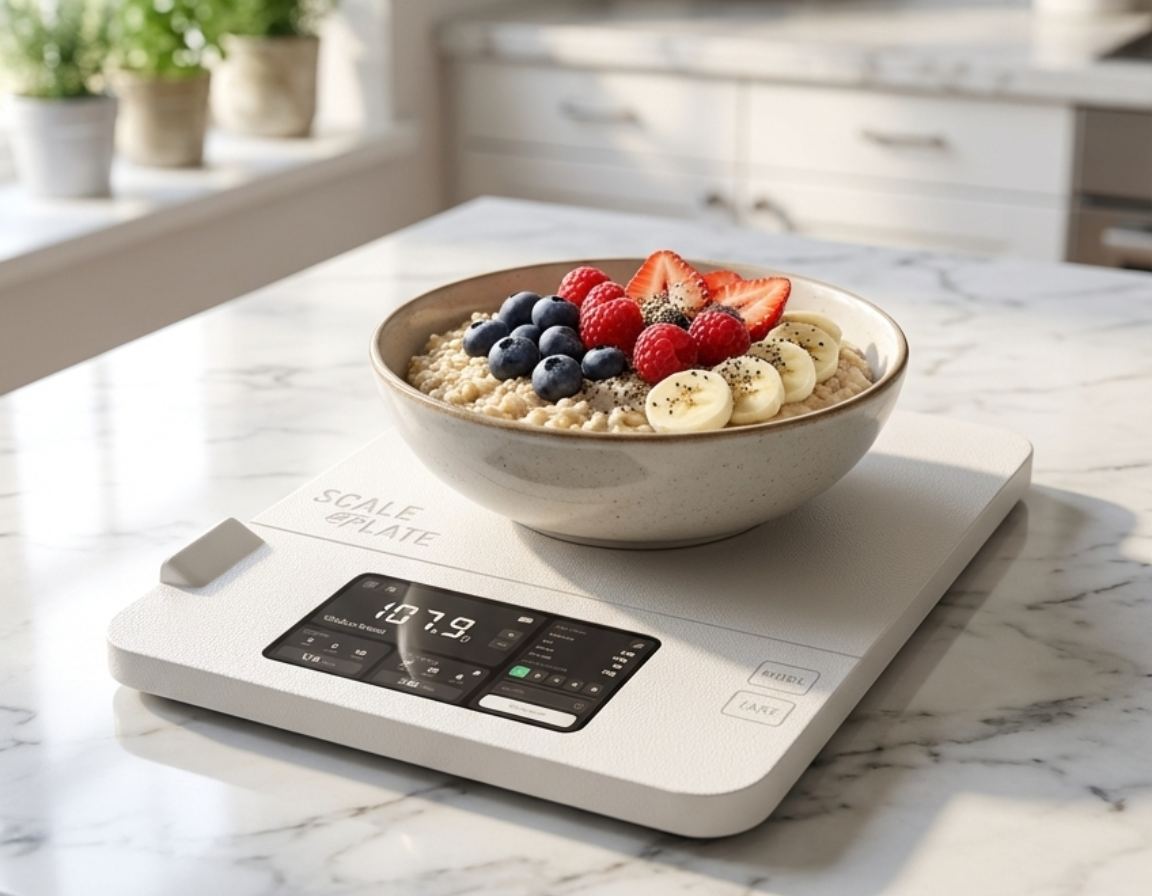
Elite athletes have nutritionists, dietitians, and support staff to keep their tracking precise. You don’t need any of that. You need a single device that makes gram-level accuracy as effortless as placing food on a plate.
Precision Features Designed for Real Daily Use
Professional-grade accuracy only matters if the workflow is simple enough to sustain. Every feature in ScaleMyPlate is designed to make precise daily tracking the path of least resistance.
Live Macro Feedback
Protein, carbs, fats, and calories update in real time as you build each meal. No second device, no logging step — you see the full macro profile as you cook.
Touchscreen Ingredient Search
Type “salmon fillet” or “sweet potato” directly on the device and it calculates macros based on exact weighed grams — no phone, no app, no searching through duplicate database entries.
Recipe and Batch Saving
Elite athletes eat on rotation. Weigh your standard meals once, save them, and recall them with one tap every day — no re-entry, no risk of picking the wrong database item twice.
Multiple User Profiles
Separate macro goals and tracking for every person on one device. Ideal for households where two people train but have different targets — no shared logs, no crossed data.
The Bottom Line
Elite athletes measure their food because imprecise nutrition makes precise training pointless. Every hour in the gym, every recovery session, every carefully planned programme — it all depends on the body receiving the right inputs in the right amounts. That’s not an elite-athlete-only principle. That’s just how physiology works.
You’ve already invested in your training. ScaleMyPlate is the investment that makes that training count — real-time macro feedback on the touchscreen, 1-gram precision from calibrated load cells, and a workflow that removes every reason to estimate instead of measure. Visit scalemyplate.com and start tracking the way the best in the world do.