Added Sugar vs Natural Sugar: What the Label Really Tells You
Not all sugar counts the same. Here’s the difference between the sugar in an orange and the sugar in a soda, how to read the label in seconds, and easy ways to cut added sugar without giving up sweetness.

Sugar might be the most confusing word in nutrition. Fruit has sugar. Milk has sugar. So does soda. Yet health guidelines treat them very differently, and the label now separates them for you, if you know where to look.
This guide explains the difference between natural and added sugar, how much added sugar is reasonable, how to read the label in seconds, and how to cut back without feeling deprived. Three tools let you compare real products, plan a day, and spot sugar hiding under other names.
- Guidelines target added sugars, not the sugar naturally inside whole fruit, vegetables and plain milk.
- Common limits: under 10% of calories (WHO), or 25 g / 36 g a day for women / men (AHA).
- On the label, read “Includes Added Sugars”, not just Total Sugars.
- Drinks, flavored yogurts, bars and sauces are the easiest places to cut.
Sugar is sugar, except when it isn’t
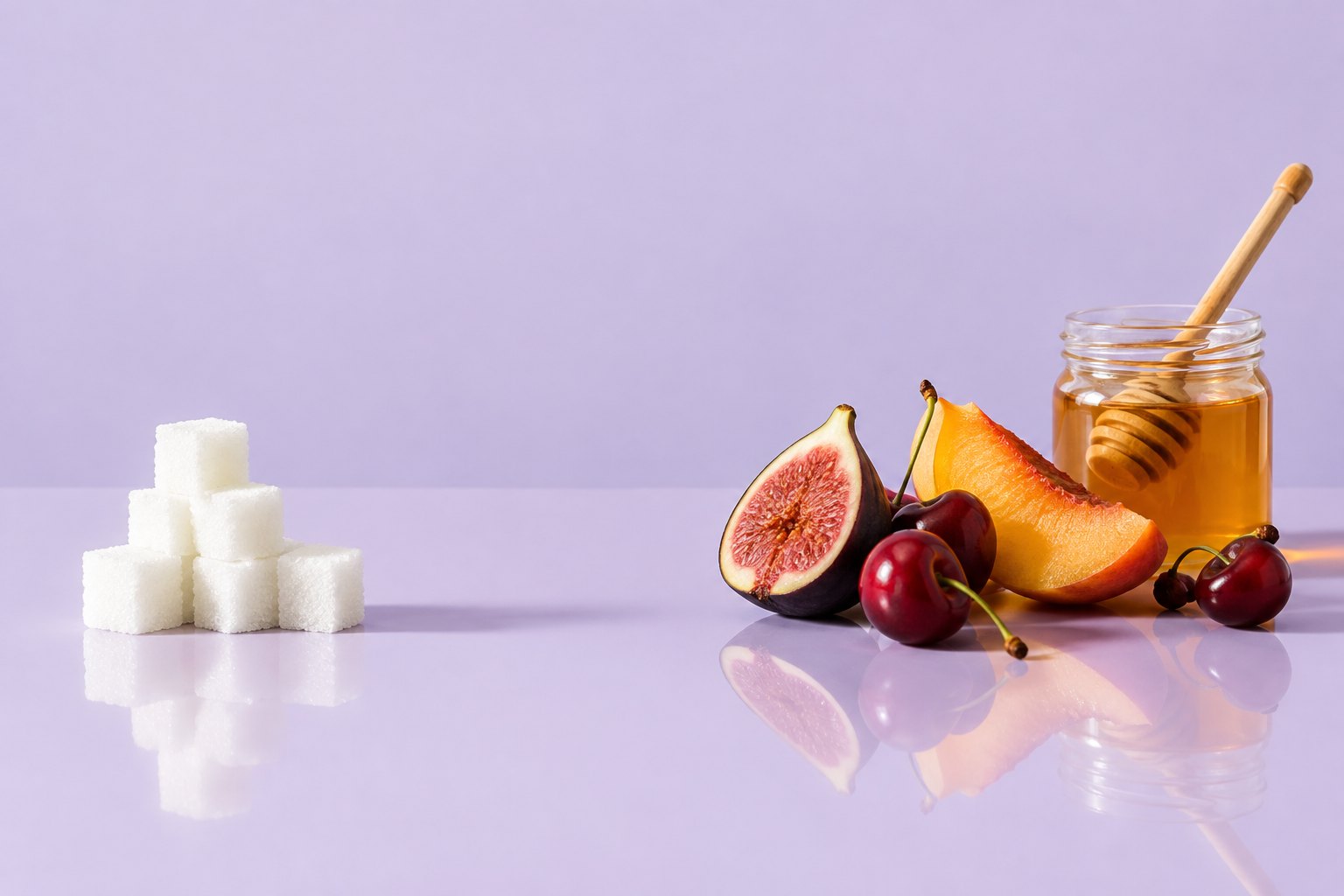
Chemically, the sugar in an apple and the sugar in a cookie are close cousins: mostly glucose, fructose and sucrose. Your body handles them in similar ways. What differs is the package. Whole fruit and plain milk bring their sugar with water, fiber, protein, vitamins and minerals, and they’re hard to overeat. Added sugars arrive concentrated, often in drinks and processed foods, and they’re easy to consume in large amounts without feeling full.
That’s why guidelines focus on added sugars (sugars and syrups added during processing or cooking) and the World Health Organization uses the slightly broader term free sugars, which also includes honey, syrups and fruit juice. The sugars naturally inside whole fruit, vegetables and plain milk aren’t on either list.
How much added sugar is reasonable?
Three benchmarks are worth knowing. The World Health Organization recommends keeping free sugars under 10% of calories (about 50 g on a 2,000-calorie diet) and suggests that going below 5% brings further benefits. The American Heart Association is stricter: about 25 g a day for women and 36 g for men. And the newest Dietary Guidelines for Americans (2025 to 2030) take the firmest line yet: they say no amount of added sugar is recommended for health, and suggest no more than about 10 g of added sugar per meal. Earlier editions reported that U.S. adults get roughly 13% of their calories from added sugars.
A single 355 ml can of regular cola has about 39 g. That’s the whole AHA budget for most women in one drink.
Reading the label in seconds
Since the U.S. Nutrition Facts label was updated, it lists Total Sugars and, indented below, Includes Added Sugars, with a Daily Value of 50 g. Total sugars include the natural ones; added sugars are the part that counts toward your limit. Compare a few typical products:
Tap a product to read its label.
The pattern to remember: plain dairy and whole fruit show sugar but no added sugar; flavored versions add it on top. Fruit juice is the special case: no added sugar on the label, but the WHO still counts it as free sugar because the fiber is gone.
Sugar has many names
Ingredient lists are ordered by weight, and manufacturers can use several types of sweetener so that none of them appears first. Tap every ingredient in this granola bar that is a form of added sugar:
There are 6 added sugars hidden in this list.
Sweetness isn’t the enemy. Sugar you didn’t notice is.
Juice vs whole fruit
A glass of orange juice and a whole orange seem equivalent. On the scale, they aren’t:
The juice takes two or three oranges to make, drops most of the fiber and goes down in seconds. The whole orange is slower to eat, more filling and brings its fiber along. If you love juice, keep the glass small and treat it as part of your sugar budget. For more on why fiber matters, read fiber explained.
Cut it without missing it
You don’t need to eliminate sweetness. Most added sugar comes from a handful of everyday sources, and simple swaps cover most of the gap. Choose your limit, then tap the swaps you’d actually make:
Notice that the dessert stayed. Cutting sugar from drinks, sauces and “healthy” snacks usually leaves plenty of room for the treats you actually care about. For a balanced view of carbohydrates overall, see carbohydrates explained.
Common questions
Your sugar plan
Pick a limit: under 10% of calories as a baseline, the AHA’s 25 to 36 g for a tighter target, or roughly 10 g per meal in line with the newest U.S. guidelines. Check the “Includes Added Sugars” line rather than total sugars. Swap sweetened drinks first, then flavored yogurts, cereals, bars and sauces. Eat fruit whole, keep juice small, and enjoy the desserts you love on purpose. Sweetness isn’t the enemy; sugar you didn’t notice is.
Read the added sugar line. Keep the treats you love.
- World Health Organization (2015). Guideline: sugars intake for adults and children. WHO.
- American Heart Association. Added sugars: how much is too much? heart.org.
- Dietary Guidelines for Americans 2025 to 2030, summarized by Harvard T.H. Chan School of Public Health.
- U.S. FDA. Added sugars on the Nutrition Facts label. FDA.
- World Health Organization (2023). Use of non-sugar sweeteners: guideline. WHO.
- Nutrient values: USDA FoodData Central and typical product labels (approximate).
Product values are typical figures for illustration; check your labels. This article is general information, not medical advice.