
Protein gets the headlines and carbs get the arguments, but fiber is the nutrient most people are quietly missing. In a large U.S. survey analysis, fewer than 1 in 10 adults met the recommended intake. The fix is simple, cheap and, done gradually, surprisingly comfortable.
This guide explains what fiber does, how much you need, the difference between the two main types, how to read a label for it, and how to increase your intake without the bloating that makes people give up. Three tools help you find your number, test your knowledge and plan the ramp-up.
- Aim for 14 g of fiber per 1,000 calories: about 25 g a day for women and 38 g for men.
- Higher fiber intakes are linked with 15 to 30% lower risk of heart disease, type 2 diabetes and early death.
- Soluble fiber (oats, beans) helps fullness and cholesterol; insoluble fiber (bran, skins) keeps things moving.
- Increase by about 5 g a week and drink water to avoid bloating.
Why fiber matters
Fiber is the part of plant foods your body can’t digest. That sounds like a flaw, but it’s the point: because it isn’t absorbed in the small intestine, fiber reaches your large intestine, where it adds bulk, holds water and feeds the bacteria that live there.
The research behind it is broad. A 2019 series of reviews in The Lancet, covering 185 prospective studies and 58 clinical trials, found that people with the highest fiber intakes had a 15 to 30% lower risk of dying from any cause or from cardiovascular disease, and lower rates of heart disease, stroke, type 2 diabetes and colorectal cancer, compared with the lowest consumers. The benefits were largest at around 25 to 29 g a day, and higher intakes looked even better. In the trials, more fiber also went with lower body weight, blood pressure and cholesterol.
For anyone managing their weight, fiber has a practical bonus: high-fiber foods tend to be bulky and slow to eat, which helps you feel full on fewer calories.
How much you need
The standard recommendation from the National Academies is 14 g of fiber for every 1,000 calories you eat. For adults up to 50, that works out to about 25 g a day for women and 38 g for men, a little less after 50. Most people eat around half that. Enter your numbers to see your target and a gentle plan to get there:
Why so slow? Your gut bacteria adapt to more fiber over a few weeks. Jumping from 12 g to 35 g overnight is the classic recipe for gas and bloating, which is why a step of a few grams a week works far better.
Two types, two jobs
Most fiber-rich foods contain a mix, but it helps to know the two main types:
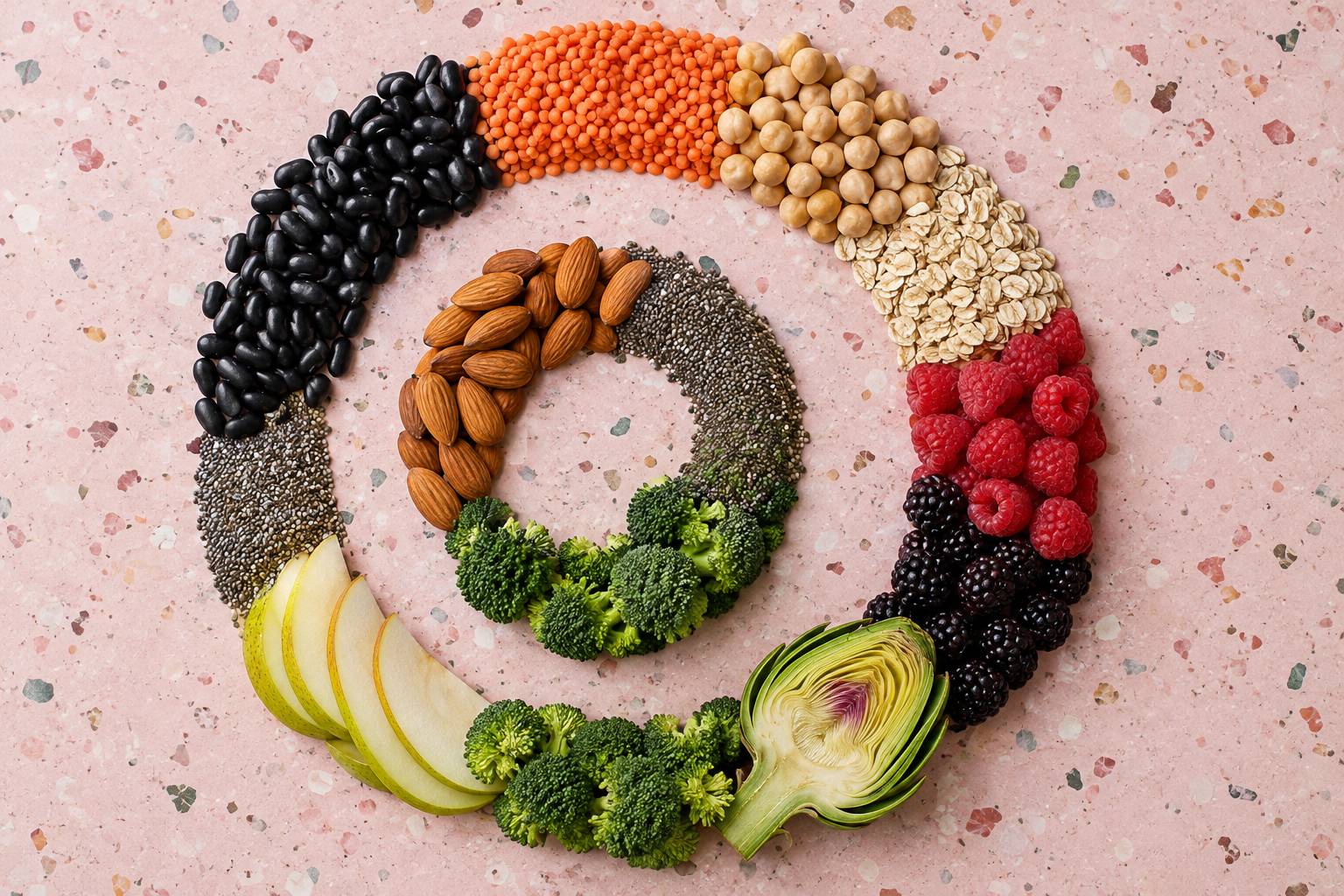
Soluble fiber dissolves in water and forms a gel. It slows digestion, helps you feel full and can lower LDL cholesterol. The best-known example is beta-glucan in oats and barley: the FDA allows a heart-health claim for foods providing it, based on about 3 g a day. Good sources: oats, barley, beans, lentils, apples, citrus and chia.
Insoluble fiber doesn’t dissolve. It adds bulk and helps food move through your gut, which supports regularity. Good sources: wheat bran, whole grains, nuts, and the skins of fruit and vegetables.
Think you can tell them apart? Sort these foods by the type of fiber they’re best known for:
Every food starts unlabeled. One tap = soluble, two taps = insoluble.
The best fiber plan isn’t a supplement. It’s beans in the soup and fruit with the skin on.
Reading the label for fiber
On a U.S. Nutrition Facts label, dietary fiber is listed under total carbohydrate, with a Daily Value of 28 g. Two claims are worth knowing: a food can be called a “good source” of fiber if one serving provides 10 to 19% of the Daily Value, and “high” or “excellent source” at 20% or more. Try a few labels:
A quick rule that works in the store: look for breads, cereals and crackers with at least 3 g of fiber per serving, and check that a whole grain is the first ingredient. To understand where the rest of the label’s numbers come from, see where calorie numbers come from.
Add it without the bloat
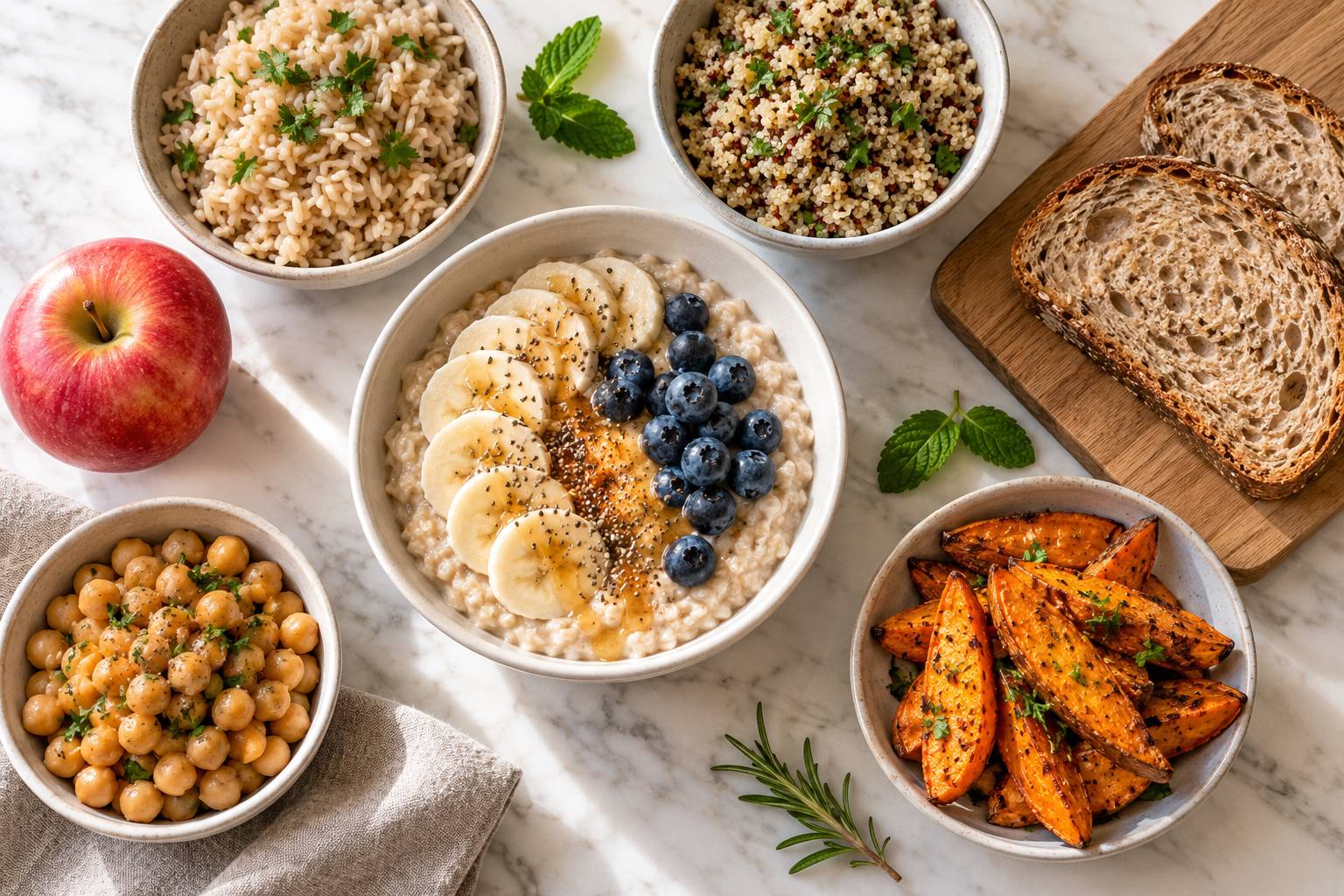
The easiest wins are swaps you barely notice: oats instead of a low-fiber cereal, a can of beans or lentils added to soup or chili, whole fruit instead of juice, and a vegetable at lunch and dinner. Legumes are the real heavyweights: half a cup of cooked lentils has about 8 g of fiber, a quarter to a third of a day’s target. Here’s what a typical portion looks like on a scale:
Weighing legumes and grains also keeps the rest of your log honest, since they bring carbs and protein along with the fiber. And drink enough water as you increase fiber, since many types of fiber work by holding water. For the bigger picture on carbohydrates, read carbohydrates explained.
Common questions
Your fiber plan
Find your target with the 14 g per 1,000 calories rule. Add about 5 g a week until you reach it. Build each day around a few anchors: oats or a whole grain at breakfast, legumes most days, two or more pieces of whole fruit, and vegetables at lunch and dinner. Drink water with it, and give your gut a few weeks to adjust. Pair it with the protein-first method and you have two of the strongest tools for feeling full on fewer calories.
Small steps, every week. Your gut will thank you.
- Reynolds A et al. (2019). Carbohydrate quality and human health: a series of systematic reviews and meta-analyses. The Lancet.
- Institute of Medicine (2005). Dietary Reference Intakes for Energy, Carbohydrate, Fiber, Fat, Fatty Acids, Cholesterol, Protein, and Amino Acids. National Academies Press.
- American Society for Nutrition (2021). Most Americans are not getting enough fiber in our diets. nutrition.org.
- U.S. FDA. Health claims: soluble fiber from certain foods and risk of coronary heart disease (21 CFR 101.81). eCFR.
- U.S. FDA. Daily Value on the Nutrition and Supplement Facts labels; nutrient content claims (21 CFR 101.54). FDA.
- Nutrient values: USDA FoodData Central (approximate).
Fiber values are typical figures for illustration. This article is general information, not medical advice.