Carbs Aren’t the Enemy: What They Actually Do, and What Happens When You Eat Too Much or Too Little
Sugar, starch, fiber, glycogen, water weight. A clear, research-backed guide to the macro everyone argues about, so you can stop fearing it and start using it.

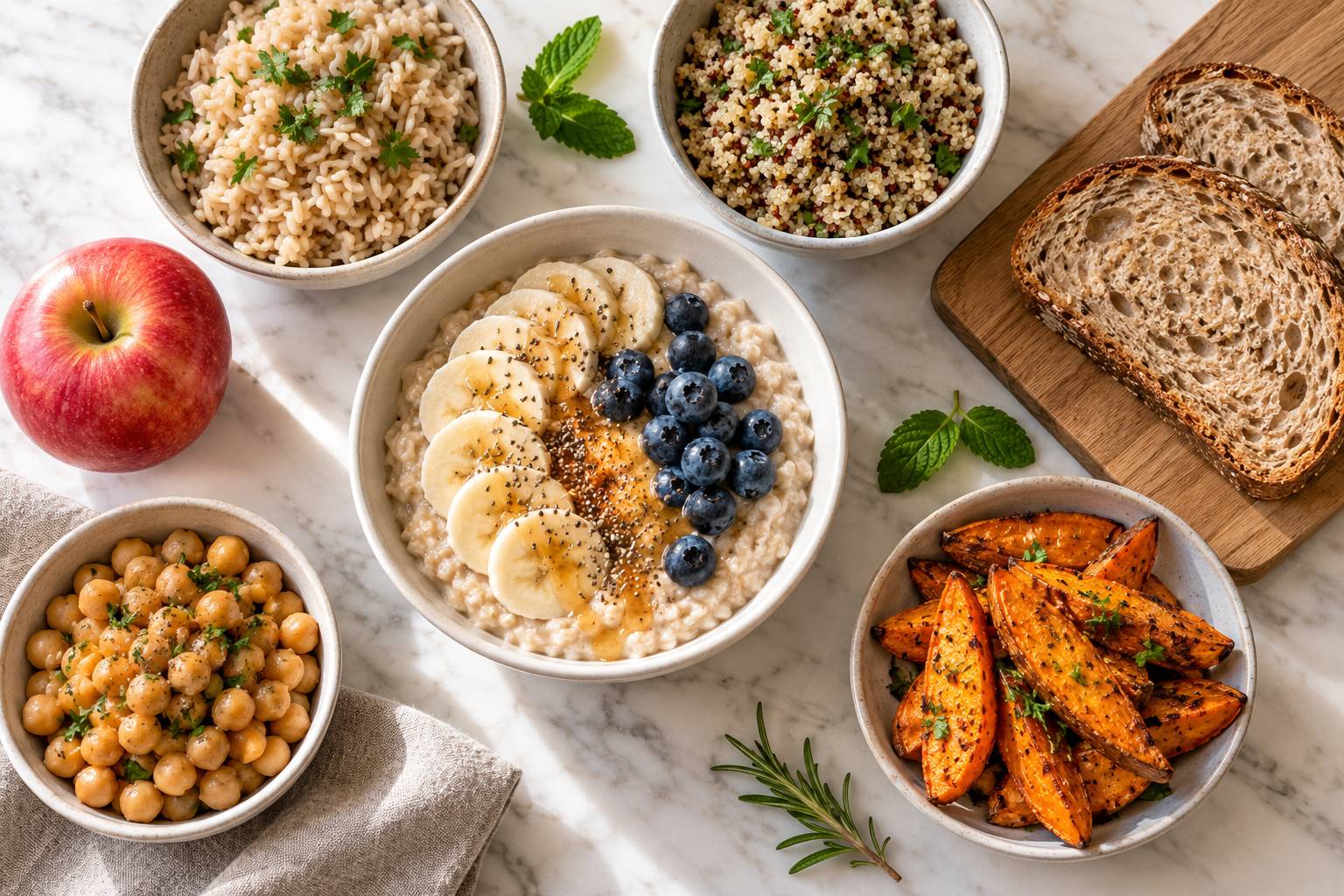
Few foods get blamed for as much as carbs. They make you fat, they spike your blood sugar, never eat them after 6 pm. Then you go for a run on an empty tank and feel like you’re dragging a sofa behind you. So which is it? Are carbs the problem, or the fuel?
The honest answer is that carbs are neither villain nor hero. They’re a tool, and like any tool, the results depend on the kind you pick and how much you use. This guide walks through what carbohydrates actually are, what your body does with them, how much an active person really needs, and what happens when you eat too little or too much. No diet tribe, just the science, explained simply.
- Carbs are your body’s fastest fuel: they feed your brain, power hard efforts, and refill a stored reserve called glycogen.
- Official guidance: at least 130 g a day, and 45 to 65% of calories. Active people often need 3 to 7 g per kg.
- Too little drains energy for hard training and causes fast “water weight” swings. Too much, especially added sugar, quietly adds surplus calories.
- Quality matters as much as quantity: aim for 25 to 29 g of fiber a day.
What carbohydrates actually are
Carbohydrates are molecules made of sugar units. Every gram of digestible carbohydrate gives your body about 4 calories, the same as protein. What changes from food to food is how those sugar units are put together, and that’s what decides how quickly they hit your bloodstream and how full they keep you.
Sugars: the short chains
Single or double sugar units, like glucose, fructose, table sugar (sucrose) and the lactose in milk. They’re absorbed quickly. They show up naturally in fruit and dairy, and they’re added to sodas, sweets and sauces.
Starches: the long chains
Hundreds of glucose units linked together, found in rice, bread, pasta, potatoes, oats and beans. Your body has to break the chain apart before it can use it, so starch is digested more gradually than pure sugar, especially when it comes with fiber.
Fiber: the part you can’t digest
Fiber is a carbohydrate your own enzymes can’t break down. It provides little to no usable energy, but it feeds the bacteria in your gut, slows down how fast other carbs are absorbed, keeps digestion regular and helps you feel full. It’s found in vegetables, fruit, whole grains, beans, nuts and seeds.
Think you can tell them apart? Try it:
What your body uses carbs for
Once carbs are digested, they enter your blood as glucose. From there, your body sends them to three main places.
Your brain. The brain runs mostly on glucose. The official recommended intake of 130 grams of carbohydrate a day is based on exactly this: the amount the brain needs to work well without having to switch to backup fuel.
Your muscles, especially when you push hard. At rest and during easy activity, your body happily burns a mix of fat and carbs. As intensity rises, think sprints, heavy sets or a fast run, it leans more and more on carbohydrate, because carbs can be turned into energy faster than fat.
Your fuel tanks. Glucose you don’t need right away gets stored as glycogen. An average adult keeps roughly 100 grams in the liver, which keeps blood sugar steady between meals, and about 400 grams in the muscles, ready for effort. Here’s the part most people never hear about: each gram of glycogen is stored with about 3 grams of water. Watch what happens to your tanks, and your scale weight, across a few common situations:
keeps blood sugar steady
fuel for hard efforts
This is why the first week of a low-carb diet often shows a dramatic drop on the scale. A big part of it is glycogen and the water stored with it, not fat. It’s also why your weight can jump a kilo after a pizza night without any real fat gain. Knowing this saves a lot of unnecessary panic.
The fastest kilo you’ll ever lose on a low-carb diet is mostly water.
How much do you actually need?
There are three useful reference points, from the most basic to the most personal:
The floor: 130 g a day. That’s the official minimum for adults, set to cover the brain’s glucose needs. Most people eat well above it.
The general range: 45 to 65% of your calories. On a 2,000-calorie day, that’s roughly 225 to 325 grams. It’s a wide range on purpose, because people’s needs and preferences differ.
The activity-based range: grams per kilo of bodyweight. Sports nutrition guidelines from the American College of Sports Medicine scale carbs to how much you train: about 3 to 5 g/kg for light or skill-based activity, 5 to 7 g/kg for around an hour of moderate exercise a day, and 6 to 10 g/kg for 1 to 3 hours of endurance training. For active everyday people, this is usually the most useful number. Explore yours, then drag the marker to where you think you eat today:
Want your carbs, protein, fat and calories worked out together? Our free Calories & Macro Calculator does the full breakdown in about a minute.
What happens when you eat too little
Cutting carbs can be a valid choice, and some people feel great on lower-carb diets. But going very low without a plan has predictable effects, and it helps to know them in advance.
With low muscle glycogen, sprints, heavy sets and intense intervals feel harder and fade sooner. Easy cardio is affected much less.
Emptying the glycogen tanks releases the water stored with them. The scale moves quickly, but it isn’t fat, and it comes back when carbs return.
Many people report headaches, tiredness and irritability during the first days of very low carb, while the body adapts to new fuel.
Cutting grains, fruit and legumes often cuts fiber too, which can mean sluggish digestion. Below about 50 g of carbs a day, the body also starts producing ketones as backup fuel.
If your goal is fat loss, here’s the key point: in one of the largest head-to-head trials, the DIETFITS study, more than 600 adults followed either a healthy low-carb or a healthy low-fat diet for a year. Average weight loss was nearly identical, about 6 kg versus 5.3 kg, with no significant difference. The best diet is the one you can actually stick to.
What happens when you eat too much
Carbs don’t make you gain fat on their own. A calorie surplus does, and it doesn’t matter much whether those extra calories come from carbs, fat or protein. But carbs, especially the refined and sugary kind, make it very easy to overshoot without noticing.
Once your glycogen tanks are full, extra energy from any source ends up stored as fat over time. Refined carbs and sugary drinks make overshooting easy because they don’t fill you up much.
The WHO links high intake of free sugars with weight gain and tooth decay. Drinks are the biggest hidden source.
A large serving of fast carbs on its own can push blood sugar up quickly and leave some people hungry or flat soon after.
When most of the plate is refined carbs, there’s less room for protein, vegetables and healthy fats, the foods that keep you full and well-nourished.
The World Health Organization recommends keeping free sugars, meaning added sugar plus the sugar in honey, syrups and fruit juice, under 10% of your calories, and ideally under 5%. On a 2,000-calorie day that’s 50 grams at most, and 25 grams to get the extra benefits. A single regular can of soda already contains about 35 to 40 grams. Note that the guideline doesn’t apply to the sugar in whole fruit, vegetables or milk.
Quality beats quantity
Two plates with the same grams of carbs can act very differently in your body. The biggest difference between them is fiber. A large review in The Lancet that pooled 185 studies and 58 clinical trials found the strongest health benefits when people ate 25 to 29 grams of fiber a day, including lower rates of heart disease, type 2 diabetes and early death. Yet the average American eats about 17 grams.
Closing that gap is easier than it sounds. A few simple swaps can double your fiber without changing how much you eat:
Approximate fiber per typical serving, based on USDA FoodData Central.
Pairing carbs with protein, fat or fiber also slows how fast they’re absorbed, which tends to mean steadier energy and longer-lasting fullness. That’s one more reason to build meals rather than graze on carbs alone. If you’re curious how this fits with protein, our guide to the protein-first method shows how to build a plate around both.
What 30 grams of carbs actually looks like
Carb-heavy foods are surprisingly different in density, which makes them hard to eyeball. Here’s the same 30 grams of carbohydrate, three ways:
Same carbs, very different portions, and very different extras: the oats bring protein and fiber, the banana brings potassium, the rice is mostly starch. It’s also why “a handful” or “a scoop” rarely matches what you log. If that sounds familiar, we explain how small portion errors add up in why macro tracking sometimes stops working. Dry rice and pasta are even trickier: they contain about three times more carbs per gram than when cooked, so always make sure your log entry matches what’s on the scale.
Common questions
Start with one swap
You don’t need to cut carbs or count every gram tomorrow. Pick one meal and make one change: swap the white bread for whole grain, add a handful of berries to breakfast, or move your biggest carb serving closer to your workout. Then notice how your energy feels. Small, repeatable changes beat dramatic diets every time.
And if you track, make sure the numbers you log match what’s actually on your plate. Any kitchen scale will get you there.
Carbs aren’t the enemy. Guessing is.
- Institute of Medicine (2005). Dietary Reference Intakes for Energy, Carbohydrate, Fiber, Fat, Fatty Acids, Cholesterol, Protein, and Amino Acids. National Academies Press.
- Thomas DT, Erdman KA, Burke LM (2016). American College of Sports Medicine Joint Position Statement: Nutrition and Athletic Performance. Medicine & Science in Sports & Exercise.
- Fernández-Elías VE et al. (2015). Relationship between muscle water and glycogen recovery after prolonged exercise in the heat in humans. European Journal of Applied Physiology.
- World Health Organization (2015). Guideline: sugars intake for adults and children. WHO.
- Reynolds A et al. (2019). Carbohydrate quality and human health: a series of systematic reviews and meta-analyses. The Lancet.
- Gardner CD et al. (2018). Effect of low-fat vs low-carbohydrate diet on 12-month weight loss: the DIETFITS randomized clinical trial. JAMA. Summary (American College of Cardiology).
- Academy of Nutrition and Dietetics (2015). Position: Health implications of dietary fiber. J Acad Nutr Diet.
- Nutrient values: USDA FoodData Central (approximate).
This article is for general information and isn’t medical or dietary advice. If you have diabetes or another medical condition, talk to a qualified professional before changing your carb intake.