
You hit your calories. Your carbs and fat look fine on paper. And yet your lifts stall, recovery feels slow, and the mirror barely changes from one month to the next. When that happens, protein is the first number worth checking. The other macros still matter, but protein is the one with a real threshold, a narrow margin for error, and almost no warning signs when you miss it.
This guide is the practical version: how much protein you need, how to spread it across your day, what 30 grams actually looks like on a plate, and the small habits that keep you from falling short. No supplements to buy and no complicated math, just the method.
- Most active people do best around 1.6 g of protein per kg of bodyweight a day. Going up to 2.2 g/kg covers individual differences.
- Spread it out: about 0.4 g/kg per meal across 3 to 5 meals beats one huge dinner.
- 20 to 40 g per meal is the practical range to switch on muscle building.
- Most “missing” protein comes from raw vs cooked mix-ups, scoops, and eyeballed portions.
Why protein plays by different rules
Carbohydrates and fat are flexible fuels. Eat a little extra and your body stores it; eat a little less and it draws on reserves. A 30-gram swing in either one on a given day barely registers over a month. Protein is different in three ways that matter.
Your body can’t bank it
There’s no dedicated storage for protein the way there is for fat or glycogen. Your muscles are constantly being broken down and rebuilt, and that rebuilding runs on the protein you eat today. Come up short and the work you did in the gym gets a weaker signal to adapt.
It works in doses
Muscle protein synthesis, the process that builds and repairs muscle, switches on when a meal delivers enough essential amino acids, especially leucine. The International Society of Sports Nutrition puts the useful range at roughly 20 to 40 grams of quality protein per meal. Below that the signal is weaker, and well above it the extra is mostly used for energy.
It’s the most filling macro
Protein keeps you full longer than carbs or fat, and your body spends more energy digesting it. That’s why getting your protein right often makes the rest of your diet easier to manage, not harder.
Your muscles respond to what you actually eat, not what you meant to eat.
How much protein do you actually need?
The official recommended intake for adults is 0.8 grams per kilogram of bodyweight. That’s the amount needed to avoid deficiency, not the amount that best supports training. For people who lift or train regularly, the research points noticeably higher.
The largest meta-analysis on the subject pooled 49 studies and nearly 1,900 people. It found that muscle gains from resistance training kept improving up to about 1.6 grams per kilogram per day, then leveled off. Because people respond differently, the authors suggested that aiming as high as 2.2 g/kg is a reasonable way to make sure you’re not leaving results on the table.
In real numbers: if you weigh 80 kg (176 lb), that’s roughly 128 to 176 grams a day. Older adults tend to need more protein per meal to get the same response, and many people aim for the higher end while dieting to help hold on to muscle. Find your own range here:
Want the full picture with calories, carbs and fat too? Our free Calories & Macro Calculator builds the complete breakdown in a minute.
Spread it out: the per-meal rule
Most people eat protein backwards: a light breakfast, a decent lunch, and most of the day’s protein at dinner. The daily total might look acceptable, but two or three of those meals never reach the threshold where muscle building really switches on.
A 2018 review in the Journal of the International Society of Sports Nutrition offers a simple target: about 0.4 grams of protein per kilogram of bodyweight per meal, across at least four meals. For an 80 kg person, that’s around 32 grams, four times a day. Compare the two days below.
Nothing extreme on either side. The difference is where the protein lands, and the protein-first day ends up 40 grams higher with every meal above 30.
What 30 grams actually looks like
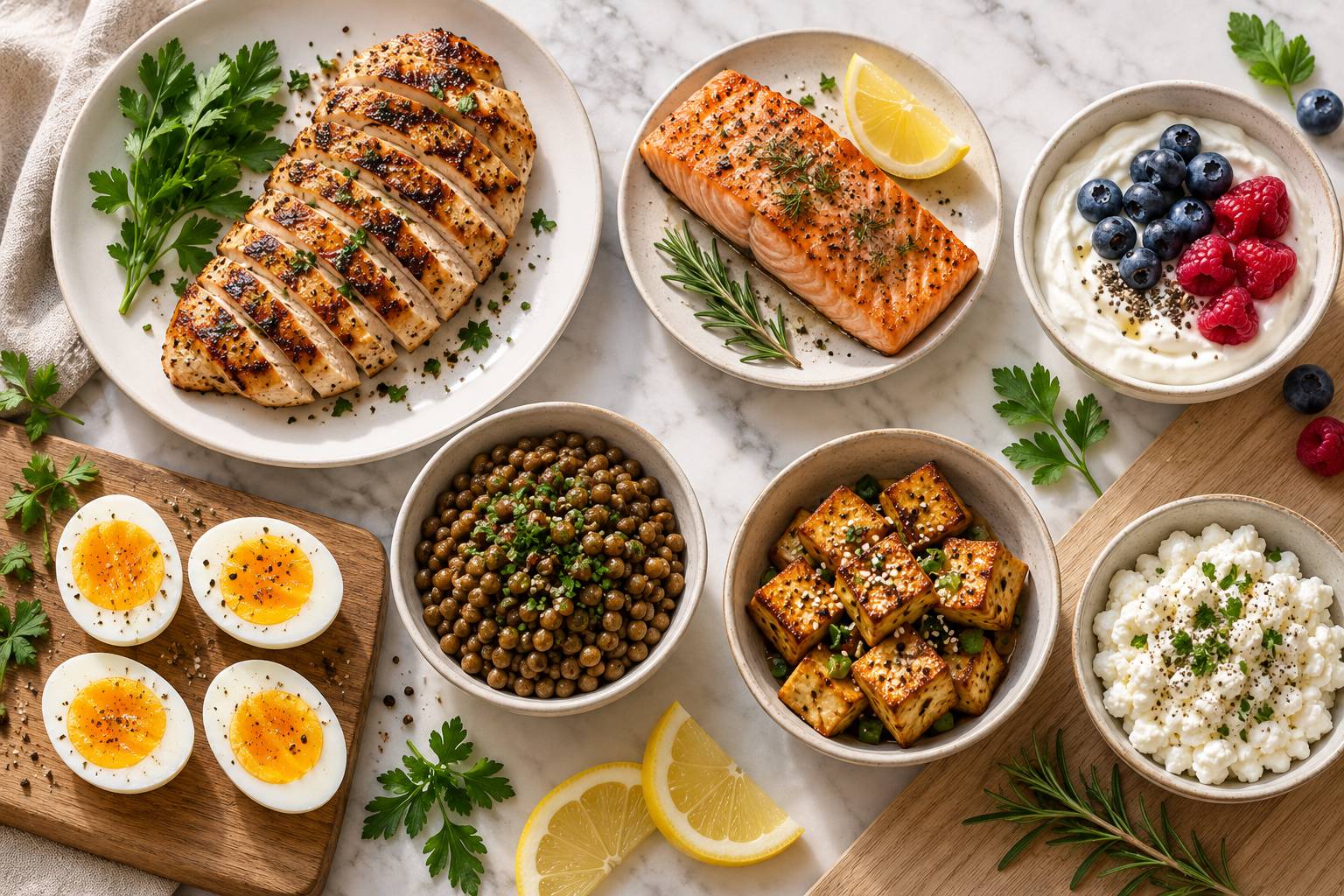
Thirty grams sounds abstract until you see it on a plate. Some meals clear it easily. Others that feel high-protein fall surprisingly short. Try building one:
Approximate values per portion as eaten. Meter goes up to 60 g.
Notice the eggs. Two large eggs give you about 13 grams, which is why an egg breakfast usually needs a side of Greek yogurt or cottage cheese to reach the bar.
Protein for the calories
If you’re trying to lose fat, it also helps to know which foods give you the most protein for the fewest calories. Some of the results are surprising: peanut butter is often called a protein food, but it delivers far more fat than protein. Switch between the two views:
Approximate values based on USDA FoodData Central.
Where protein quietly goes missing
This is the part most guides skip. Even people who track carefully routinely miss their protein target, and it’s rarely about effort. A few common habits simply throw the numbers off.
Raw vs cooked
Meat and fish lose water as they cook, usually shrinking by 20 to 30 percent. A 200 g raw chicken breast ends up around 145 g cooked, but it contains exactly the same protein. Weigh it cooked and log it with a raw entry, and you’ll undercount by about a quarter. Do the reverse and you’ll overcount. The fix is simple: pick one way and make sure the entry matches.
Scoops and spoons
A level scoop of whey and a heaped one can differ by 6 to 8 grams of protein. With two shakes a day, that’s up to 16 grams of drift from the food most people consider the easiest to track.
Eyeballed portions
Chicken breasts range from about 120 to 280 g. Treating every one as “a medium breast” can swing a single meal by 20 grams, more than 12 percent of a 160 g daily goal. Restaurant portions vary just as much: a “6 oz” chicken breast can easily arrive closer to 5 or 7 oz.
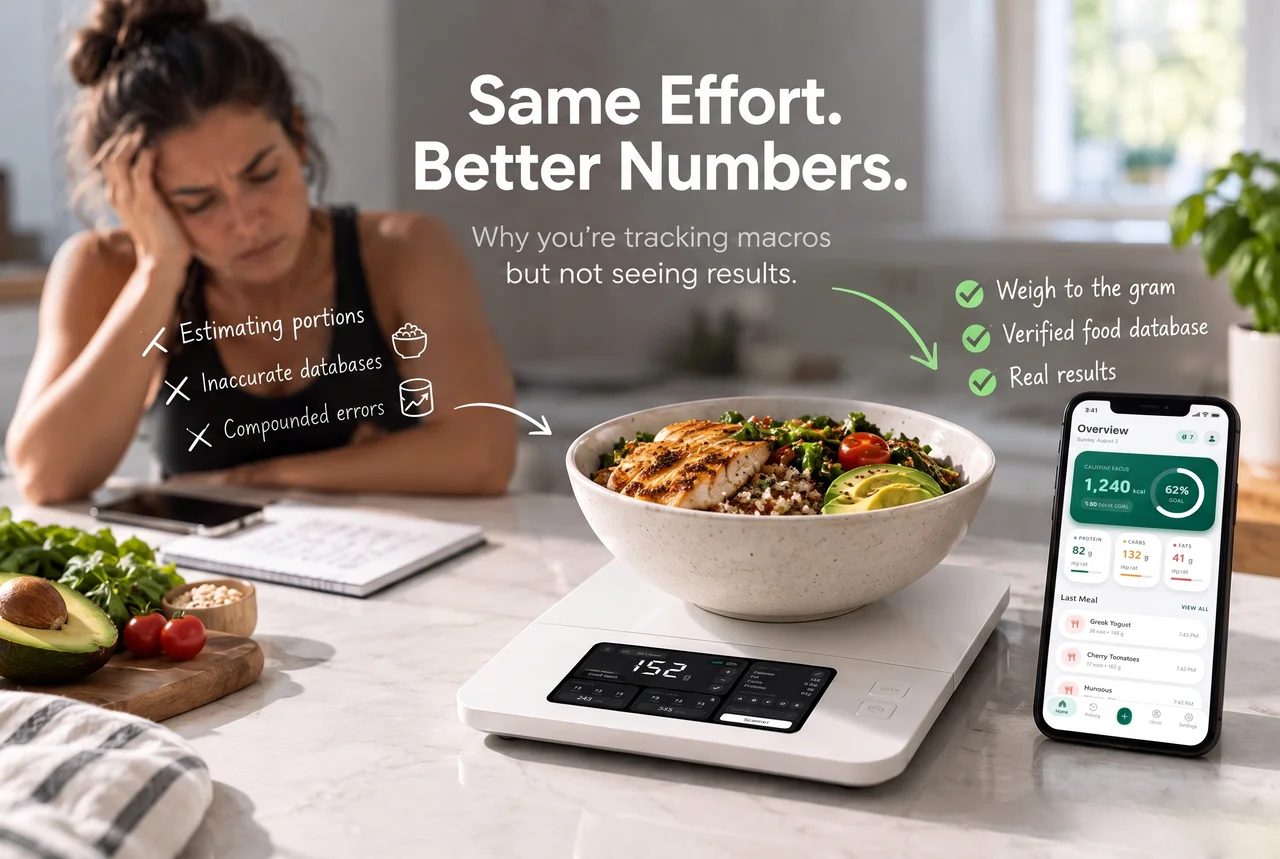
None of these errors is big on its own. The problem is that they repeat. Miss by 20 grams a day and that’s 140 grams a week, about three cooked chicken breasts’ worth of protein your training never received. We dig into how small errors compound in why macro tracking sometimes stops working, and why manual tracking has a hidden problem.
The protein-first method, step by step
Put everything above together and you get a simple routine. It works with any scale and any tracking app.
- 1Set your floorUse the calculator above. Treat that number as a minimum, not a goal to hit “most days”.
- 2Anchor every mealPlan each meal around a protein source first (about 0.4 g/kg), then add carbs, fats and vegetables around it.
- 3Measure the anchorWeigh your main protein source, at least for a few weeks until your eye is calibrated. Raw or cooked, just stay consistent.
- 4Log as you goLog while you cook, not from memory at night. It takes seconds and removes the guesswork.
Here’s what that looks like in a normal day of eating:
Nothing exotic. Every meal is simply built around a protein source first, and the total takes care of itself. People who eat this way usually notice two things within a couple of weeks: their daily protein becomes far more consistent, and their appetite settles, because protein is the most filling macro.
Common questions
Start with one meal
You don’t need to overhaul everything tomorrow. Pick one meal, usually breakfast, and get it to 30 grams. Once that feels automatic, do the same for the next one. Within a few weeks, hitting your protein target stops being something you think about.
The only thing that really matters is that the numbers you log match what’s on your plate. Any kitchen scale will get you there.
Protein first. Everything else follows.
- Morton RW et al. (2018). A systematic review, meta-analysis and meta-regression of the effect of protein supplementation on resistance training-induced gains in muscle mass and strength. British Journal of Sports Medicine.
- Schoenfeld BJ, Aragon AA (2018). How much protein can the body use in a single meal for muscle-building? Journal of the International Society of Sports Nutrition.
- Jäger R et al. (2017). International Society of Sports Nutrition Position Stand: protein and exercise. JISSN.
- Nutrient values: USDA FoodData Central (approximate).
This article is for general information and isn’t medical or dietary advice. Protein needs vary; talk to a qualified professional about your situation.