
The Key Tool That Separates Nutrition and Fitness Goal Achievers
Two people can follow the same training programme, eat roughly the same foods, and get completely different results. One hits their goal in 12 weeks. The other is still guessing why nothing’s moving six months later. The difference almost always comes down to one thing — and it’s not motivation, genetics, or the plan itself.

The One Variable That Separates Results from Frustration
Ask anyone who’s consistently hit a physique or performance goal what made the difference, and almost every answer circles back to the same thing: they knew exactly what they were eating. Not roughly. Not approximately. Exactly.
That 33-point accuracy gap isn’t abstract. At 2,000 calories a day, it’s the difference between knowing your intake and being off by up to 660 calories — enough to completely cancel a training deficit or surplus without a single conscious mistake in your log.
Three Reasons Most People Stay Stuck
Goal achievers aren’t more disciplined, more knowledgeable, or more motivated than people who stay stuck. They’ve just removed the three specific friction points that make consistent tracking collapse.
They’re measuring volume, not weight
Cups, tablespoons, and handfuls vary wildly depending on how densely food is packed. A “cup of oats” can range from 80g to 130g depending on how it’s scooped. That’s a 200-calorie swing on a single ingredient. Volume measurements feel accurate and aren’t. Weight measurements are accurate and feel like extra effort — until you make them a habit.
They’re logging after eating instead of before
Logging from memory introduces two errors simultaneously: portion recall (you ate more than you think) and food identity (you pick the wrong entry from the database). Studies show post-meal logging underestimates intake by 12–25% on average. Real-time logging — weighing and recording as you build the meal — eliminates both errors before they happen.
They’re tracking calories without separating macros
Hitting 2,000 calories with 80g of protein produces a completely different body composition outcome than hitting 2,000 calories with 160g of protein — even in the same training programme. Calorie counting tells you how much energy you consumed. Macro tracking tells you what your body is actually being given to work with. That distinction is where results live.
Why the Tool You Use Determines Whether You Stick With It
The single biggest predictor of whether precision tracking produces results isn’t accuracy — it’s consistency. And consistency is entirely a function of friction. The harder the process, the earlier people abandon it. Here’s how common tracking tools compare on what actually drives long-term use:
Every row in that table is a friction point where the standard workflow creates a reason to skip a step. Skip enough steps and your data becomes unreliable. Unreliable data produces no useful feedback. No feedback means no adjustments — and no results.
What Goal Achievers Actually Have in Common
The people who hit their goals aren’t the ones who try harder. They’re the ones who removed every excuse to stop tracking accurately.
The core insight behind precision nutrition toolsWhen you look at what consistent goal achievers do differently, four behaviours show up repeatedly. None of them require unusual discipline — they’re all the natural result of having a workflow that makes precision the easiest option:
They weigh every ingredient, every time
Not most of the time. Every time. The habit becomes automatic in two to three weeks once the process stops requiring effort.
They log before eating, not after
Real-time logging eliminates memory error and makes it impossible to underestimate a portion you’ve already weighed and recorded.
They use repeatable meals
Most people eat 6–10 meals on rotation. Saving those meals and recalling them with one tap eliminates the re-entry fatigue that kills consistency by week three.
They adjust weekly based on real data
Consistent, precise intake data gives them something to act on. When body composition doesn’t respond, they can see exactly what to change — and why.
The Tool That Makes All Four Behaviours Effortless
Each of those four behaviours is a direct product of how easy the tracking process is. Make logging fast and the habit sticks. Make it slow and it doesn’t — regardless of how motivated you were on day one.
The reason most people can’t sustain precision tracking isn’t discipline. It’s that their tools were designed for occasional use, not daily precision. A cheap scale that drifts. A phone app that requires six interactions per ingredient. A database full of duplicate entries with different calorie counts. That’s not a precision tracking system — it’s a system that makes precision feel impossible.
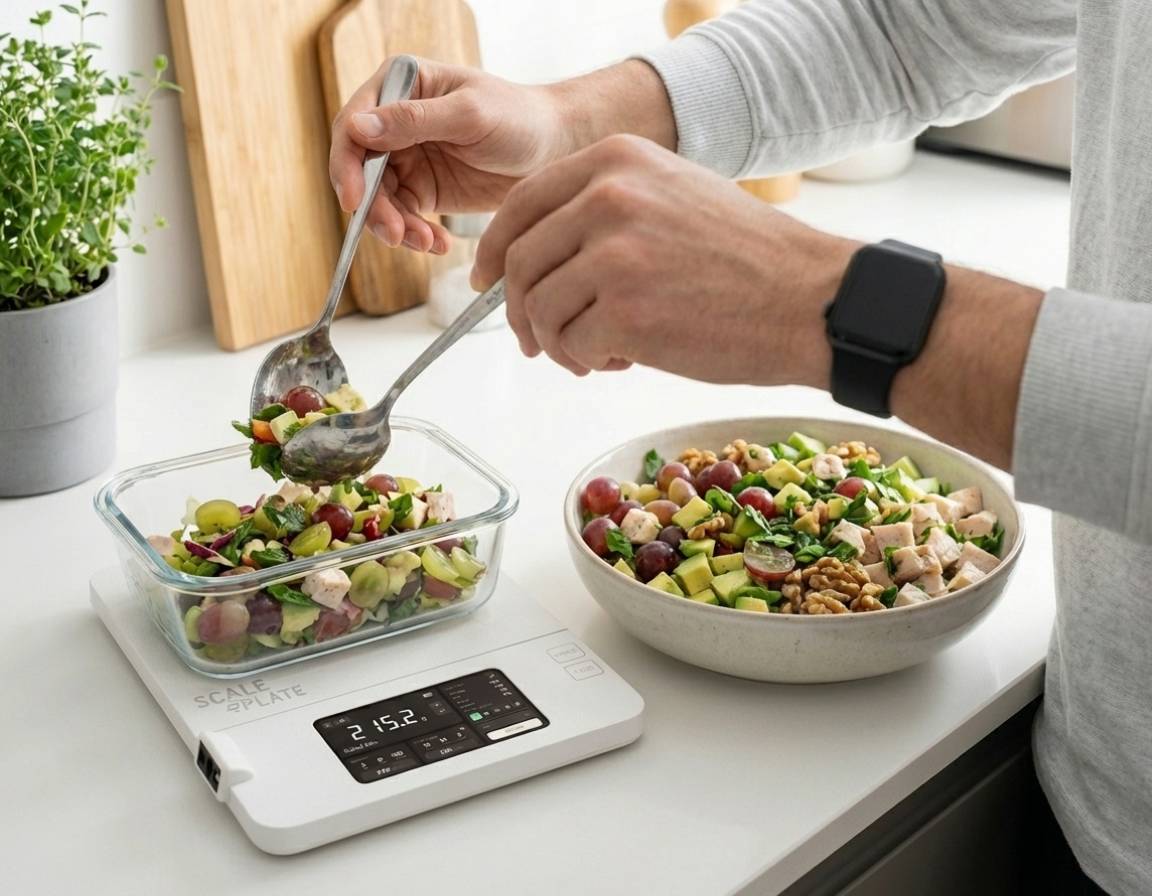
Precision by Design, Not by Willpower
Every feature in ScaleMyPlate exists to eliminate a specific friction point that causes tracking to break down. This is what that looks like in practice.
Live Macro Feedback
Protein, carbs, fats, and calories appear on the touchscreen as you build the meal — not after you’ve finished eating. You see the full picture before the first bite.
Built-In Barcode Scanner
Scan packaged foods directly on the device. Nutrition data populates instantly from a verified database — no phone, no duplicate entries to sift through.
Multiple User Profiles
One device, separate tracking for every person in the household. Individual macro goals, individual data — no crossed logs or shared accounts.
Verified Nutrition Database
No AI guessing, no image recognition, no 15% error rates. ScaleMyPlate uses a verified nutrition database matched to exact gram weight — the same standard used in professional nutrition practice.
The Bottom Line
The gap between people who hit their nutrition and fitness goals and people who don’t isn’t talent, time, or effort. It’s data quality — and the tool that produces it. Every person who gave up on macro tracking wasn’t failing the approach. The approach was failing them, because the tools made precision harder than it needed to be.
When the right tool removes the friction, precision becomes the default — not the exception. ScaleMyPlate is that tool: real-time macro feedback on the touchscreen, 1-gram accuracy from calibrated load cells, built-in barcode scanning, and no monthly fees. Visit scalemyplate.com and start tracking with the accuracy your goals actually require.